

[2022] New QSDA2019 exam dumps Use Updated Qlik Exam
Verified QSDA2019 Dumps Q&As - QSDA2019 Test Engine with Correct Answers
NEW QUESTION 22
A data architect needs to upload data from ten different sources, but only if there are any changes after the last reload When data is updated, a new file is placed into a folder mapped to E:\373948870. The data connection points to this folder.
The data architect plans a script which will:
1. Verify that the file exists
2. If the file exists, upload it. Otherwise, skip to the next piece of code.
The script will repeat this subroutine for each source. When the script ends, all uploaded files will be removed with a batch procedure. Which option should the data architect use to meet these requirements?
- A. FilePath, IF, THEN, Drop
- B. FilePath, FOR EACH, Peek, Drop
- C. FileSize, IF, THEN, END IF
- D. FileExists, FOR EACH, IF
Answer: D
NEW QUESTION 23
Refer to the exhibit.
A clothing retailer wants to review their product pricing strategy.
A data architect must classify each product into a price group. The price groups must be the same width by default and allow users to dynamically change the width of the bucket during analysis.
Which feature should the data architect use to meet these requirements?
- A. Class function in the script and use variables
- B. Nested IFs in a calculated dimension
- C. IntervalMatch and use variables
- D. Class function in a calculated dimension
Answer: D
NEW QUESTION 24
Refer to the exhibit.
A data architect is loading the tables and a synthetic key is generated.
How should the data architect resolve the synthetic key?
- A. Remove the LineNo field from both tables and use the AutoNumber function on the OrderlD field
- B. Create a composite key using OrderlD and LineNo, and remove OrderlD and LineNo from Shipments
- C. Remove the LineNo field from Shipments and use the AutoNumber function on the OrderlD field
- D. Create a composite key using OrderlD and LineNo
Answer: D
NEW QUESTION 25
A company generates 1 GB of ticketing data daily. The data is stored in multiple tables Business users need to see trends of tickets processed for the past two years. Users very rarely access the transaction-level data for a specific date. Only the past two years of data must be loaded which is 720 GB of data Which method should a data architect use to meet these requirements?
- A. Load only two years of data and use best practices in scripting and visualization to calculate and display aggregated data
- B. Load only aggregated data for two years and use ODAG for transaction data
- C. Load only aggregated data for two years and use Direct Discovery for transaction data
- D. Load only two years of data in an aggregated app and create a separate transaction app for occasional use
Answer: B
NEW QUESTION 26
A data architect creates a collection of large QVD files that propagate data into their apps This solution works well.
However, a new app that uses a subset of the data in a QVD takes much longer than expected to reload The LOAD statement is
Which two changes should be made to improve load performance? (Select two ) A)
B)
C)
D)
- A. Option A
- B. Option B
- C. Option D
- D. Option C
Answer: A
NEW QUESTION 27
Refer to the exhibits.
A business analyst needs to see the currency conversion rate for any given date in a chart The currency conversion rate data comes from Qlik DataMarket and only contains a record when the rate changes An existing master calendar exists in the data model which contains a full set of dates Which technique should the data architect use to meet this requirement?
- A. Use IntervalMatch to load the currency conversion rate between dates the conversion changed Inner Join the resultant table back into the master calendar
- B. Outer Join the calendar with the currency conversion table Order by the date and use the Peek function to fill in blank values
- C. Use a FOR loop between the start date and end date of the master calendar Use the Match function to add the currency conversion rates to the master calendar
- D. Use IterNo and AutoGenerate to create a new calendar from max and mm dates of the currency conversion table Force concatenate with the master calendar
Answer: B
NEW QUESTION 28
A data architect needs to create an app that combines employee data from the Sales system and the Human Resources (HR) system.
These systems identify employees differently. Employees in the HR system are identified with an alpha-numeric key. Employees in the Sales system are identified using an integer key The Human Resources manager creates a table which maps these keys to one another, called Associations.
The resultant data model must meet the following requirements:
* Associations must be valid
* The model must be optimized for performance
* The option must support multiple tables added from both systems now and in the future Which function should the data architect use to meet these requirements?
- A. RENAME FIELDS USING Associations;
- B. APPLYMAP { 'Associations' , EmployeeKey) AS EmployeeKey;
- C. MAP EmployeeKey USING Associations;
- D. MapSubString('Associations', EmployeeKey) AS EmployeeKey;
Answer: B
NEW QUESTION 29
Refer to the exhibit.
A data architect loads sales data and creates a table which shows only customers who made purchases in 2018 and 2019. The data architect applies the following set analysis expression on the sales measure. Count<{<Year={'2 018'}, CustomerID=P({<Year={'2019*}>})>} Customer ID) Which option shows the resulting table after the expression is applied?
A)
B)
C)
D)
- A. Option B
- B. Option C
- C. Option A
- D. Option D
Answer: D
NEW QUESTION 30
A data architect needs to upload different data sources. To properly handle null values, the data architect decides to set all of these values to "Missing Value".
Which syntax should the data architect use?
- A. NullasNull *;
Set NullValue = 'Missing Value'; - B. NullAsValue*;
Set NullValue = 'Missing Value'; - C. NullAsValue*; Set NullValues = 'Missing Value';
- D. NullasNull *;
Set NullValues = 'Missing Value';
Answer: A
NEW QUESTION 31
A data architect plans to build an app that contains geographically diverse data that must be specific to user run-time selections. The source contains transactional data.
The app must have minimal impact on already limited server resources.
Which approach should the data architect use?
- A. Loop and Reduce
- B. In-memory
- C. QVDs
- D. ODAG
Answer: A
NEW QUESTION 32
Refer to the exhibit.

Refer to the exhibits.
While using an app, the users report that some Sales Reps do NOT have personal details, like Division or Address Number A data architect has been called in to investigate.
The data architect uses the data model viewer to determine the relationship between the SalesRepMaster and CustomerMaster tables.
What is the cause of the issue?
- A. 26 values for Sales Rep are null in CustomerMaster
- B. 59.3% of the Sales Rep have CustomerMaster information
- C. 40.7% of the Sales Rep have CustomerMaster information
- D. Density is 100% while Total Distinct and Present Distinct are NOT the same
Answer: D
NEW QUESTION 33
Refer to the exhibit.
USER1 has an app protected using this Section Access statement.
Which countries can USER1 see in the app''
- A. Germany. Italy, United Kingdom, The Netherlands
- B. Germany Italy, The Netherlands
- C. Italy, United Kingdom, The Netherlands
- D. Italy, The Netherlands
Answer: B
NEW QUESTION 34
A customer has a dataset that contains latitude and longitude data for service points around the country. The data is retrieved using the following statement:
It must be clear to the end user that this is geographic dat
a. Drag and drop, map-based visualization of this data is required. Which two steps should the data architect take to support this data? (Select two.)
- A. Add the following to the end of the script:
TAG FIELD LocationName With 'Sgeoname', *@relates_Pt';
TAG FIELD Point With 'Sgeopoint*f 'Srelates Location', '$hidden'; - B. Add GeoProject{' Point' , Lat&Long) AS Point to the preceding load
- C. Define Location as a master item, and set the tag to Sgeodata
- D. Add GeoKakePoint (Lat, Long} as Point to Location's preceding load
- E. Add the following to the end of the script:
TAG FIELD LocationName With 'Sgeodata1, 'Srelated'; TAG FIELD Point With 'Sgeodata', 'Srelated1;
Answer: E
NEW QUESTION 35
A human resources (HR) team manager is due to go on leave. The manager needs to assign permissions to colleague to help the HR team publish apps. Which action(s) should the manager assign to the colleague before going on leave?
- A. Publish
- B. Owner Publish
- C. Publish, Read
- D. Owner Publish, Read
Answer: C
NEW QUESTION 36
Refer to the exhibit.
A shipping company needs to track its shipments using Qlik Sense A data architect has the data in Excel as shown on the left Business rules state that if the ShipmentDate field is empty, it should be populated with the first valid previous date as shown on the right. Which script should the data architect use to meet this requirement?
A)
B)
C)
D)
- A. Option A
- B. Option B
- C. Option D
- D. Option C
Answer: A
NEW QUESTION 37
A data architect needs to create an app to analyze 30-day re-admissions at a hospital.
* The medical record system does NOT calculate re-admission data
* The business rule to follow: if a patient is admitted to a hospital within 30 days after being discharged from a previous hospital stay, that event should be captured in the app with a flag called "30-day Re-admission"
* Data being used from the patient record includes hospital account ID, patient ID, admission dater and discharge dateWhich action should the data architect perform first to meet these requirements?
- A. Sequence patient records by patient ID using the Peek function
- B. Calculate the days since previous discharge using admission date and discharge date
- C. Sequence patient records by hospital account ID and patient ID using the Peek function
- D. Order patient records by patient ID and admission date
Answer: C
NEW QUESTION 38
Refer to the exhibit.
This table contains information about the number of admissions and discharges of patients in a hospital. The values can be positive or negative. The data architect needs to create an extra column that contains the number of patients that are currently in the hospital.
Which script should the data architect use ?
A)
B)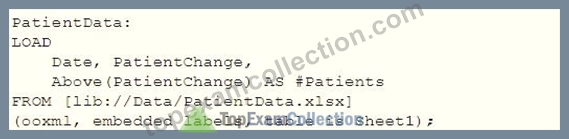
C)
D)
- A. Option A
- B. Option B
- C. Option D
- D. Option C
Answer: A
NEW QUESTION 39
A data architect needs to load data from two different databases. Additional data will be added from a folder that contains QVDs, text files, and Excel files. What is the minimum number of data connections required?
- A. Five
- B. Four
- C. Two
- D. Three
Answer: C
NEW QUESTION 40
Refer to the exhibit.
A global sales organization operates in three regions: AMERICAS, EMEA: and APAC. Each region stores its sales transactions in a separate database in which the employees update customer data through a third-party app. The data is extracted into three QVDs.
A data architect sets up a two-tier architecture for the data load. The data architect needs to add the region to the data model.
Which technique should the data architect use to create the Region field?
- A. Create a Region field in the Employee table and populate using the SubField function on the EmployeelD
- B. Create a Region field in the SalesTransaction table and create a mapping table based on the Country field in the Customer table
- C. Create a Region field in the Employee table and populate using the LTrim function on the EmployeelD
- D. Create a Region field in the SalesTransaction table and populate using fixed region values while loading from each source
Answer: B
NEW QUESTION 41
A data architect needs to write the expression for a measure on a KPI to show the sales person with the highest sales. The sort order of the values of the fields is unknown. When two or more sales people have sold the same amount, the expression should return all of those sales people.
Which expression should the data architect use?
- A. FirstSortedValue {Salesperson, -Aggr (Sum{Sales), Salesperson))
- B. Concat(DISTINCT IF{Aggr{Rank{Sum(Sales),4),Salesperson)=1,Salesperson),' ')
- C. FirstSortedValue{DISTINCT Salesperson,-Aggr{Sum(Sales),Salesperson))
- D. Concat(DISTINCT IF{Aggr{Rank{Sum(Sales),1),Salesperson)=1, Salesperson) , ' ')
Answer: B
NEW QUESTION 42
A data architect needs to load large amounts of data from a database which is continuously updated New records are added, and existing records get updated and deleted. Each record has a LastModified field All existing records are exported into a QVD file. The data architect wants to load the records into Qlik Sense efficiently.
Which steps should the data architect take to meet these requirements?
- A. 1. Load the existing data from the QVD.
2. Load the new and updated data from the database without the rows that have just been loaded from the QVD. Concatenate with data from the QVD.
3. Load all records from the key field from the database and use an Inner Join on the previous table. - B. 1. Load the new and updated data from the database
2. Load the existing data from the QVD without the updated rows that have just been loaded from the database. Concatenate with the new and updated records.
3. Load all records from the key field from the database and use an Inner Join on the previous table. - C. 1. Load the existing data from the QVD.
2. Load new and updated data from the database. Concatenate with the table loaded from the QVD.
3. Create a separate table for the deleted rows and use a WHERE NOT EXISTS to remove these records. - D. 1. Use a partial load to load new and updated data from the database.
2. Load the existing data from the QVD without the updated rows that have just been loaded from the database. Concatenate with the new and updated records.
3. Use the Peek function to remove the deleted rows.
Answer: D
NEW QUESTION 43
......
Qlik QSDA2019 Exam Syllabus Topics:
| Topic | Details |
|---|---|
| Topic 1 |
|
| Topic 2 |
|
| Topic 3 |
|
| Topic 4 |
|
| Topic 5 |
|
| Topic 6 |
|
| Topic 7 |
|
| Topic 8 |
|
| Topic 9 |
|
| Topic 10 |
|
Pass Your QSDA2019 Dumps as PDF Updated on 2022 With 52 Questions: https://examcompass.topexamcollection.com/QSDA2019-vce-collection.html
