

2026 Updated Verified FCSS_ADA_AR-6.7 Q&As - Pass Guarantee or Full Refund
[May-2026] FCSS_ADA_AR-6.7 Certification with Actual Questions from TopExamCollection
Fortinet FCSS_ADA_AR-6.7 Exam Syllabus Topics:
| Topic | Details |
|---|---|
| Topic 1 |
|
| Topic 2 |
|
| Topic 3 |
|
| Topic 4 |
|
NEW QUESTION # 35
Refer to the exhibit.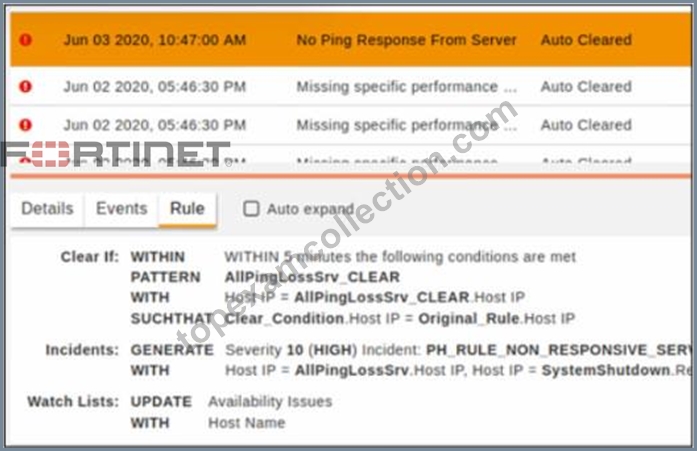
Why was this incident auto cleared?
- A. Within five minutes the packet loss percentage dropped to a level where the reporting IP is the same as the host IP
- B. The original rule did not trigger within five minutes
- C. Within five minutes, the packet loss percentage dropped to a level where the reporting IP is same as the source IP
- D. Within five minutes, the packet loss percentage dropped to a level where the host IP of the original rule matches the host IP of the clear condition pattern
Answer: D
NEW QUESTION # 36
When automating remediation in FortiSIEM, what should be carefully considered?
- A. The number of users currently logged in?
- B. The aesthetic layout of the FortiSIEM dashboard?
- C. The frequency of software updates?
- D. The potential impact of the automated action on business operations?
Answer: D
NEW QUESTION # 37
Refer to the exhibit.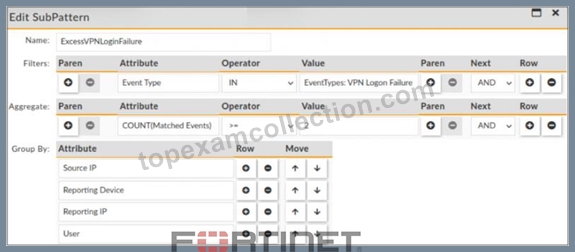
The rule evaluates multiple VPN logon failures within a ten-minute window.
Consider the following VPN failure events received within a ten-minute window: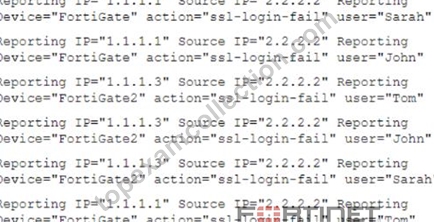
How many incidents are generated?
- A. 0
- B. 1
- C. 2
- D. 3
Answer: C
NEW QUESTION # 38
Refer to the exhibit.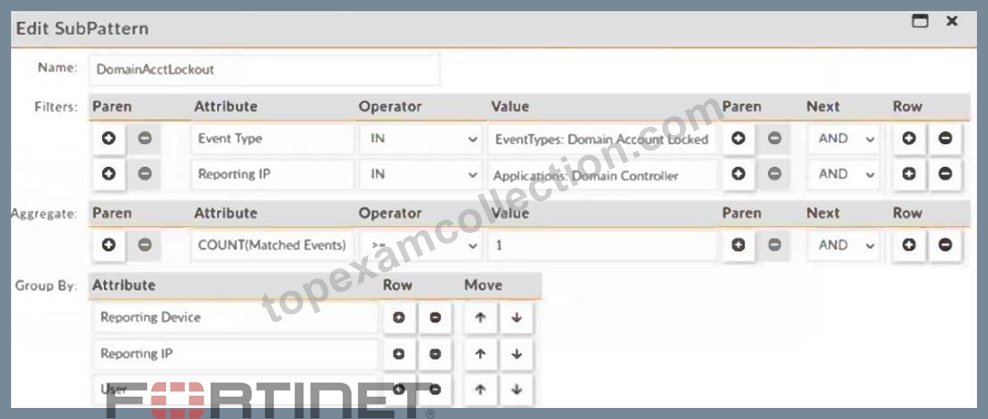
Which statement about the rule filters events shown in the exhibit is true?
- A. The rule filters events with an event type that belong to the Domain Account Locked CMDB group and a user that belongs to the Domain Controller applications group.
- B. The rule filters events with an event type that belong to the Domain Account Locked CMDB group or a reporting IP that belong to the Domain Controller applications group.
- C. The rule filters events with an event type that belong to the Domain Account Locked CMDB group and a reporting IP that belong to the Domain Controller applications group.
- D. The rule filters events with an event type that equals Domain Account Locked and a reporting IP that equals Domain Controller applications.
Answer: C
Explanation:
From the Filters section in the exhibit, we see:
1. Event Type IN EventTypes: Domain Account Locked
2. Reporting IP IN Applications: Domain Controller
3. Logical Operator: AND
Since both conditions must be true, the rule is effectively filtering events where:
*The event type belongs to the Domain Account Locked CMDB group
*The reporting IP belongs to the Domain Controller applications group
NEW QUESTION # 39
Which function of Linux is used by FortiSIEM for collecting logs?
- A. aureport
- B. autrace
- C. ausearch
- D. auditd
Answer: D
NEW QUESTION # 40
Why can collectors not be defined before the worker upload address is set on the supervisor?
- A. Collectors can only upload data to a worker, and the supervisor is not a worker
- B. Collectors receive the worker upload address during the registration process
- C. To ensure that the service provider has deployed a NFS server
- D. To ensure that the service provider has deployed at least one worker along with a supervisor
Answer: B
NEW QUESTION # 41
Refer to the exhibit.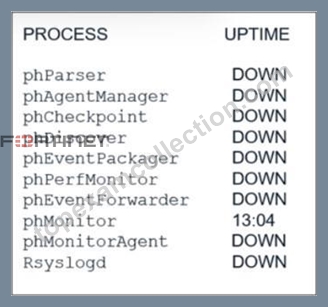
An administrator deploys a new collector for the first time, and notices that all the processes except the phMonitor are down.
How can the administrator bring the processes up?
- A. Rebooting the collector will bring up the processes.
- B. The administrator needs to run the command phtools --start all on the collector.
- C. The processes will come up after the collector is registered to the supervisor.
- D. The collector was not deployed properly and must be redeployed.
Answer: C
NEW QUESTION # 42
FortiSIEM's UEBA capabilities primarily focus on:
- A. Streamlining the software update process?
- B. Ensuring all users have similar access privileges?
- C. Monitoring and analyzing behavior patterns to identify potential risks?
- D. Providing encryption algorithms for data transfers?
Answer: C
NEW QUESTION # 43
When you perform a Group By on a structured query, which two outcomes occur? (Choose two.)
- A. Group By automatically applies a COUNT aggregation.
- B. Group By cannot be applied to an aggregated function.
- C. Group By is applied to historical searches only.
- D. Group By is applied to real-time and historical searches.
Answer: A,D
Explanation:
Group By automatically applies a COUNT aggregation.
When using Group By in FortiSIEM structured queries, it automatically applies a COUNT(*) function unless a different aggregation (such as SUM, AVG, or MAX) is specified. This helps summarize data by counting occurrences of grouped attributes.
Group By is applied to real-time and historical searches.
Grouping functions work in both real-time (live event monitoring) and historical (past event analysis) searches, making it useful for trend analysis, anomaly detection, and correlation.
NEW QUESTION # 44
Refer to the exhibit.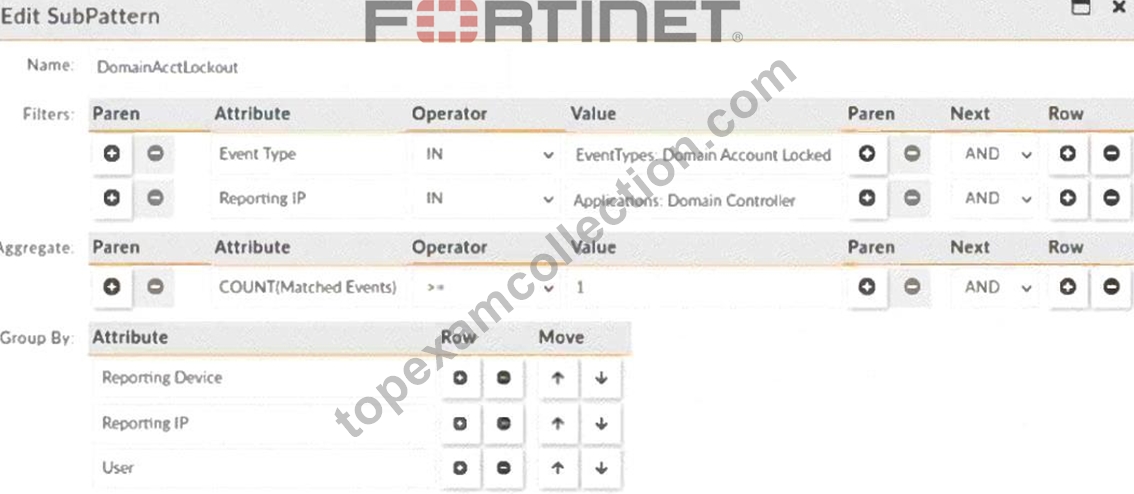
Consider the five account locked events received by FortiSIEM from domain controllers within the last 10 minutes (ten minutes is the evaluation window for the subpattern DomainAcctLockout):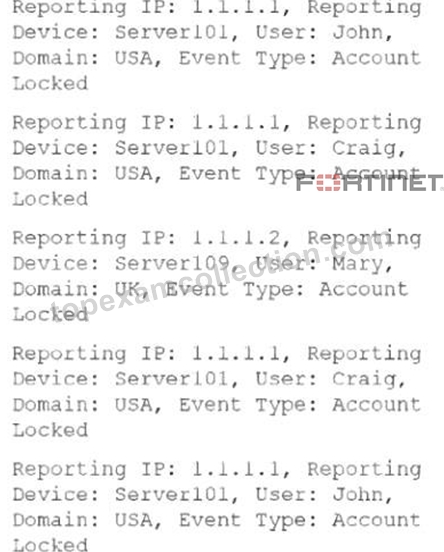
If you look for one or more matching events and groupings by the same reporting IP address, reporting device, and user, how many incidents are created?
- A. 0
- B. 1
- C. 2
- D. 3
Answer: B
Explanation:
The rule groups events by Reporting IP, Reporting Device, and User. Let's analyze the five events:
Events Received:
1. Reporting IP: 1.1.1.1, Reporting Device: Server101, User: John
2. Reporting IP: 1.1.1.1, Reporting Device: Server101, User: Craig
3. Reporting IP: 1.1.1.2, Reporting Device: Server109, User: Mary
4. Reporting IP: 1.1.1.1, Reporting Device: Server101, User: Craig (Duplicate of #2)
5. Reporting IP: 1.1.1.1, Reporting Device: Server101, User: John (Duplicate of #1) Grouping Based on:
# Reporting IP
# Reporting Device
# User
Count unique groups:
1. (1.1.1.1, Server101, John) # 2 occurrences (counted as one group)
2. (1.1.1.1, Server101, Craig) # 2 occurrences (counted as one group)
3. (1.1.1.2, Server109, Mary) # 1 occurrence (counted as one group)
Since we need at least one matching event (count >= 1) per group, incidents are created for each unique group.
Total unique groups (incidents created) = 2
# John on Server101 (1.1.1.1)
# Craig on Server101 (1.1.1.1)
NEW QUESTION # 45
Refer to the exhibit.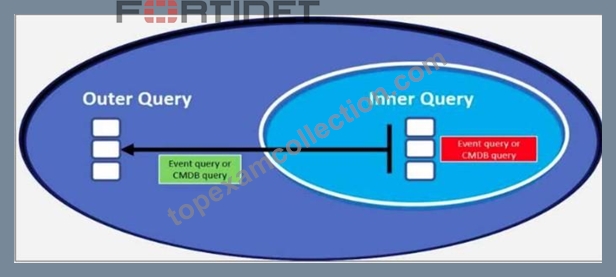
Which scenario is not a supported nested query scenario?
- A. The outer query is the event query, and the inner query is the event query.
- B. The outer query is the event query, and the inner query is the CMDB query.
- C. The outer query is the CMDB query, and the inner query is the CMDB query.
- D. The outer query is the CMDB query, and the inner query is the event query.
Answer: C
Explanation:
FortiSIEM does not allow CMDB queries to be nested within other CMDB queries. CMDB data is static information, and nesting would not add value or function properly in query execution.
NEW QUESTION # 46
What are the modes of Data Ingestion on FortiSOAR? (Choose three.)
- A. App Push
- B. Policy based
- C. Notification based
- D. Rule based
- E. Schedule based
Answer: A,D,E
Explanation:
FortiSOAR supports multiple data ingestion modes to allow efficient data collection and automation. The three primary modes are:
1. Rule-Based
2. App Push
3. Schedule-Based
NEW QUESTION # 47
How can you invoke an integration policy on FortiSIEM rules?
- A. Through remediation scripts
- B. Through Incident Notification settings
- C. Through Notification Policy settings
- D. Through External Authentication settings
Answer: C
Explanation:
InFortiSIEM, anintegration policycan be invokedthrough Notification Policy settings. This allows automated responses such as:
# Sending alerts toexternal systems (e.g., SIEMs, ticketing systems, SOAR platforms).
# Triggering actions based on specificincident rules.
# Integrating withthird-party solutionsforremediation, escalation, or logging.
NEW QUESTION # 48
Refer to the exhibit.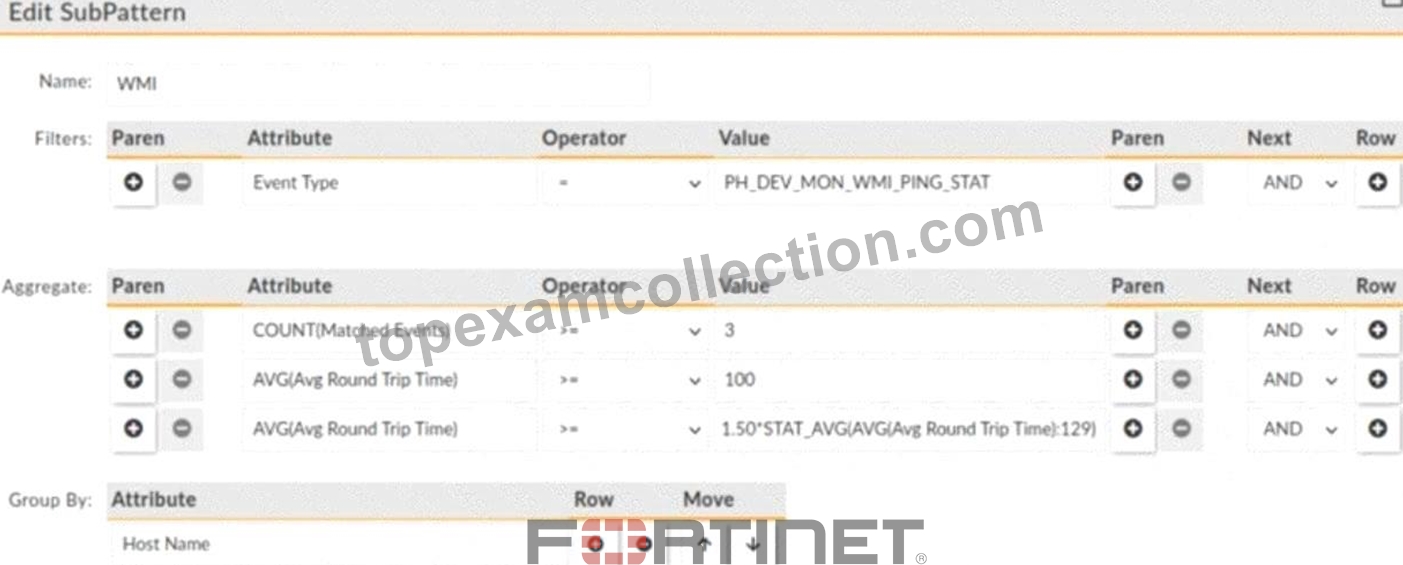
The window for this rule is 30 minutes.
What is this rule tracking?
- A. A sudden 150% increase in WMI response times over a 30-minute time window
- B. A sudden 75% increase in WMI response times over a 30-minute time window
- C. A sudden 50% increase in WMI response times over a 30-minute time window
- D. A sudden 1.50 times increase in WMI response times over a 30-minute time window
Answer: A
Explanation:
The rule is tracking asudden increase in WMI response timesover a30-minute window. The key detail here is the increase factor.
# The term1.50 times increasemeans the new value is150%of the previous baseline.
# A1.50x increasecorresponds to a150% increase, since the new value isoriginal + 150% of original.
NEW QUESTION # 49
Refer to the exhibit.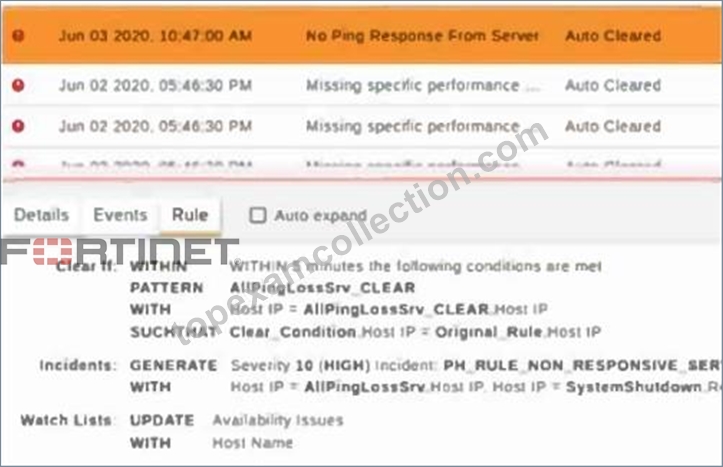
Why was this incident auto cleared?
- A. Within five minutes the packet loss percentage dropped to a level where the reporting IP is the same as the host IP
- B. The original rule did not trigger within five minutes
- C. Within five minutes, the packet loss percentage dropped to a level where the reporting IP is same as the source IP
- D. Within five minutes, the packet loss percentage dropped to a level where the host IP of the original rule matches the host IP of the clear condition pattern
Answer: D
Explanation:
From the "Clear If" condition in the exhibit:
*WITHIN 5 minutes, the system checks if the pattern AllPingLossSrv_CLEAR occurs.
*The Host IP of the clear condition must match the Host IP of the original rule (Clear_Condition.Host IP = Original_Rule.Host IP).
*If this condition is met, the system automatically clears the incident because it indicates that network connectivity has been restored (packet loss has dropped).
Thus, the incident was auto-cleared because the system detected that the issue was resolved within the defined 5-minute window, meeting the conditions for auto-clearance.
NEW QUESTION # 50
How can you invoke an integration policy on FortiSIEM rules?
- A. Through remediation scripts
- B. Through Incident Notification settings
- C. Through Notification Policy settings
- D. Through External Authentication settings
Answer: C
NEW QUESTION # 51
Refer to the exhibit.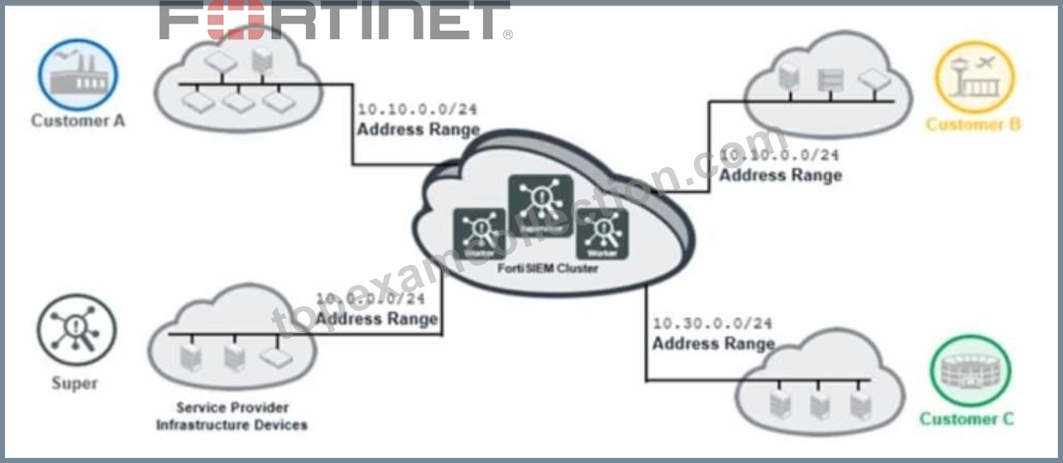
The service provider deployed FortiSIEM without a collector and added three customers on the supervisor.
What mistake did the administrator make?
- A. Customer A and customer B have overlapping IP addresses.
- B. At least one collector must be deployed to collect logs from service provider infrastructure devices.
- C. Collectors must be deployed on all customer premises before they are added to organization on the supervisor.
- D. The number of workers on the FortiSIEM cluster must match the number of customers added
Answer: B
Explanation:
The administrator deployed FortiSIEM without a collector, meaning there is no dedicated system collecting logs from service provider infrastructure devices. Without a collector, the FortiSIEM supervisor and workers must directly ingest logs, which is not ideal for a multi-tenant service provider setup. A collector is necessary to efficiently gather logs before forwarding them to the FortiSIEM cluster.
NEW QUESTION # 52
Why do collectors communicate with the Supervisor after registration? (Choose two.)
- A. To report the health status of the agents
- B. To receive templates associated with agents
- C. To report its own health status
- D. To upload event data if a worker down
Answer: C,D
Explanation:
After registration, collectors maintain continuous communication with the Supervisor to ensure proper event processing, system health monitoring, and failover handling. The two key reasons collectors communicate with the Supervisor are:
1. To upload event data if a worker is down
2. To report its own health status
NEW QUESTION # 53
Identify the processes associated with Machine Learning/Al on FortiSIEM. (Choose two.)
- A. phRuleMaster
- B. phReportMaster
- C. phAnomaly
- D. phFortiInsightAI
- E. phRuleWorker
Answer: C,D
NEW QUESTION # 54
A service provider purchased a licensed EPS of 520 and the total unused events is 72,000. Calculate the total amount of allowed events for the next 3-minute interval.
- A. 192,456
- B. 192,446
- C. 192,442
- D. 192,450
Answer: A
NEW QUESTION # 55
Refer to the exhibit.
The exhibit shows the output of an SQL command that an administrator ran to view the natural_id value, after logging into the Postgres database.
What does the natural_id value identify?
- A. The supervisor
- B. An agent
- C. The collector
- D. The worker
Answer: C
Explanation:
The natural_id value in the ph_sys_connector table of the FortiSIEM Postgres database uniquely identifies a collector.
*The SQL query retrieves details from ph_sys_connector, which stores information about registered collectors.
*The cust_org_id field indicates the organization ID the collector belongs to.
*The name field shows the collector's name (OrgA_Collector).
*The ip_addr field lists the collector's IP address (10.10.2.91).
*The natural_id value uniquely identifies the collector in the system.
NEW QUESTION # 56
How can you empower SOC by deploying FortiSOAR? (Choose three.)
- A. Reduce human error
- B. Collaborative knowledge sharing
- C. Address analyst skills gap
- D. Aggregate logs from distributed systems
- E. Baseline user and traffic behavior
Answer: A,B,C
NEW QUESTION # 57
Refer to the exhibit.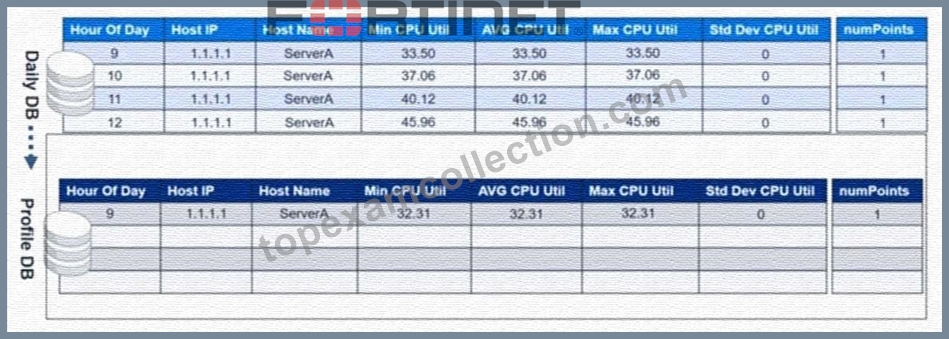
The profile database contains CPU utilization values from day one. At midnight on the second day, the CPU utilization values from the daily database will be merged with the profile database.
In the profile database, in theHour of Daycolumn where9is the value, what will be the updated minimum, maximum, and average CPU utilization values?
- A. Min CPU Util=33.50, Max CPU
Util=33.50 and AVG CPU
Util=33.50 - B. Min CPU Util=32.31, Max CPU
Util=33.50 and AVG CPU
Util 33.50 - C. Min CPU Util=32.31, Max CPU
Util=32.31 and AVG CPU
Util=32.31 - D. Min CPU Util=32.31, Max CPU
Util=33.50 and AVG CPU
Util=32.67
Answer: D
Explanation:
Atmidnight, thedaily database valuesmerge into theprofile database. The new values forHour 9are calculated as follows:
#Minimum CPU Utilization:The new minimum is the lower of the existing (32.31) and new (33.50) values
#32.31
#Maximum CPU Utilization:The new maximum is the higher of the existing (32.31) and new (33.50) values
#33.50
#Average CPU Utilization:
# The previous average was32.31(from one point).
# The new value from the daily database is33.50(one additional point).
# The new average is calculated as:
Thus, after merging, the updated profile database values forHour 9are:
#Min CPU Util = 32.31
#Max CPU Util = 33.50
#Avg CPU Util = 32.67
NEW QUESTION # 58
Refer to the exhibit.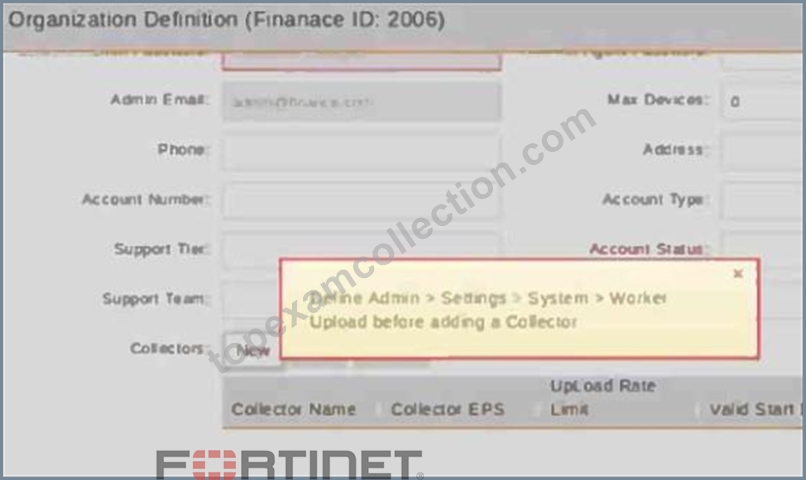
A service provider does not have a dedicated worker in the cluster, but still wants to add a collector to an organization.
What option does the administrator have?
- A. Ignore the warning and continue adding the collector
- B. Define a pseudo address as a worker IP address
- C. Define the supervisor IP address as a worker unload address
- D. Install a worker
Answer: C
Explanation:
In FortiSIEM, collectors need to upload event logs to a worker node for processing. However, if there is no dedicated worker, the supervisor can function as the worker to receive data.
*The error message suggests that a worker upload address must be defined before adding a collector.
*Since there is no dedicated worker, the administrator can set the Supervisor IP as the upload destination to enable log collection.
NEW QUESTION # 59
When explaining FortiSIEM rule processing, which of the following elements is crucial?
- A. The sequence in which rules are processed?
- B. The color-coding of FortiSIEM logs?
- C. The visual design of the FortiSIEM interface?
- D. The brand of servers on which FortiSIEM is installed?
Answer: A
NEW QUESTION # 60
......
FCSS_ADA_AR-6.7 Real Valid Brain Dumps With 61 Questions: https://examcompass.topexamcollection.com/FCSS_ADA_AR-6.7-vce-collection.html
